

Case Study: AI B2B2C Struggling With Activation, Adaptation & Pricing - Playbook to 10x Their Business
A step-by-step diagnostic using Behavioral Systematic Clarity to fix what traditional metrics miss


Hey everyone,
Another from the series of case study from my personal experience, not just analyzing some huge popular companies. I hope these will be more relevant for some of you, and I also need them for marketing purposes. So they might be a couple more, but I believe this is a win-win scenario, so hopefully, you too!
Not only that, but for the first time, I will introduce one of my frameworks. Try to use it for your business, and if you find something you won’t understand, or you use it and it brings you results, please share that with me! I love to hear those kind of messages.
Let’s get into it….
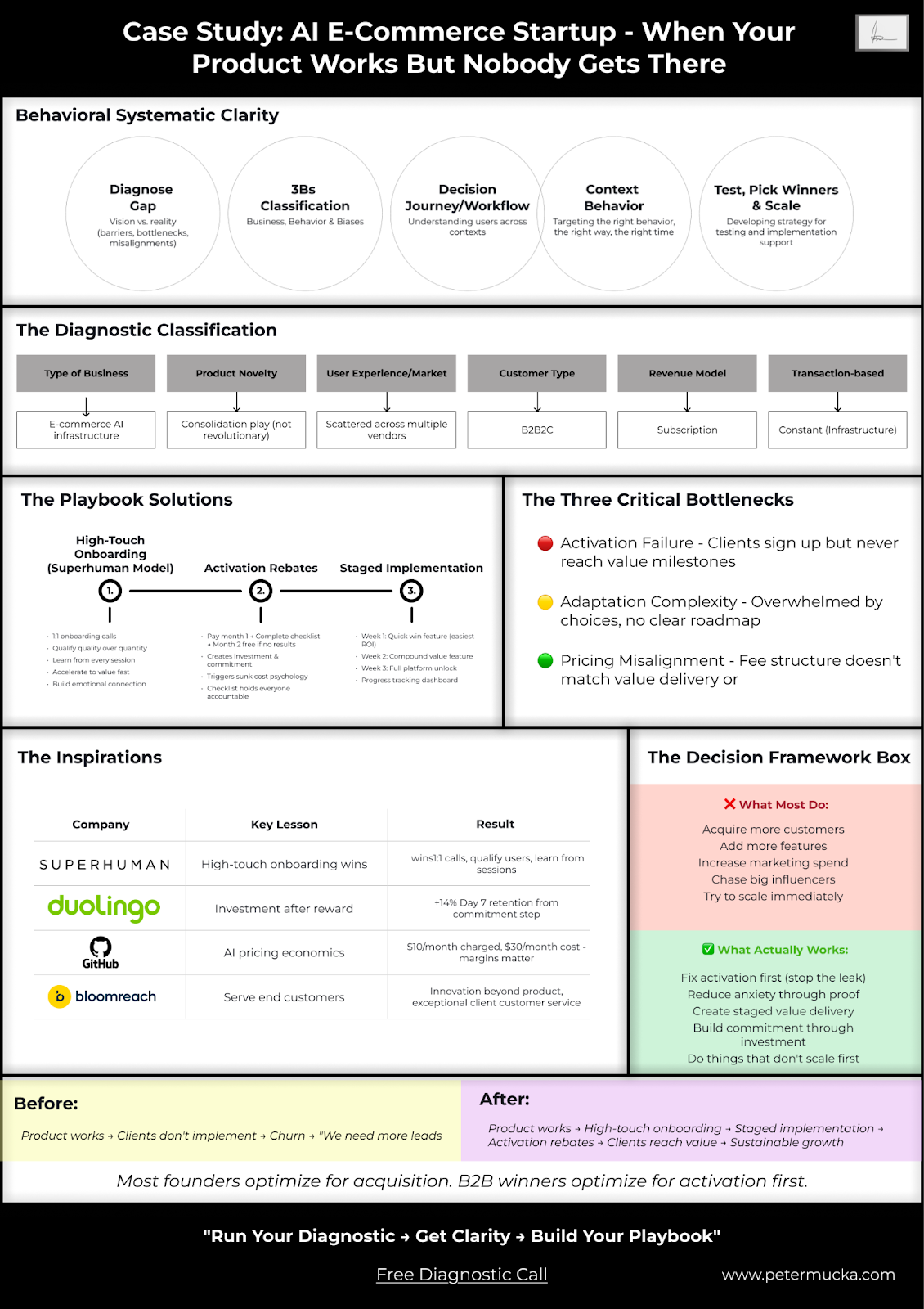
I had an interesting consultation with a startup from which I needed to write a case study because it might help many others.
An AI e-commerce startup had a problem most founders would kill for: their product actually delivered, big time. Clients who fully implemented the platform saw ROI in the first month. Real money, measurable results, the whole deal.
The problem? Almost too few clients got to full implementation.
They were bleeding customers at activation, not acquisition. People signed up, did not fully integrate the product, and churned before experiencing any value. The product worked. The onboarding process didn’t.
This is a diagnostic for a B2B2C AI startup (think AI sales agents, search engines, recommendation systems - the full suite for e-commerce). What makes this valuable isn’t just the solutions, but showing you the methodology I use.
Because most behavioral frameworks are built for massive companies or policy-making. Product frameworks aren’t systematic enough. So I built my own.
In this article, I will show you how addressing these bottlenecks can 10x the business, and why general advice like acquire more customers would break the product eventually, or would waste too many resources.
This is Behavioral Systematic Clarity in action. Here’s how it works:
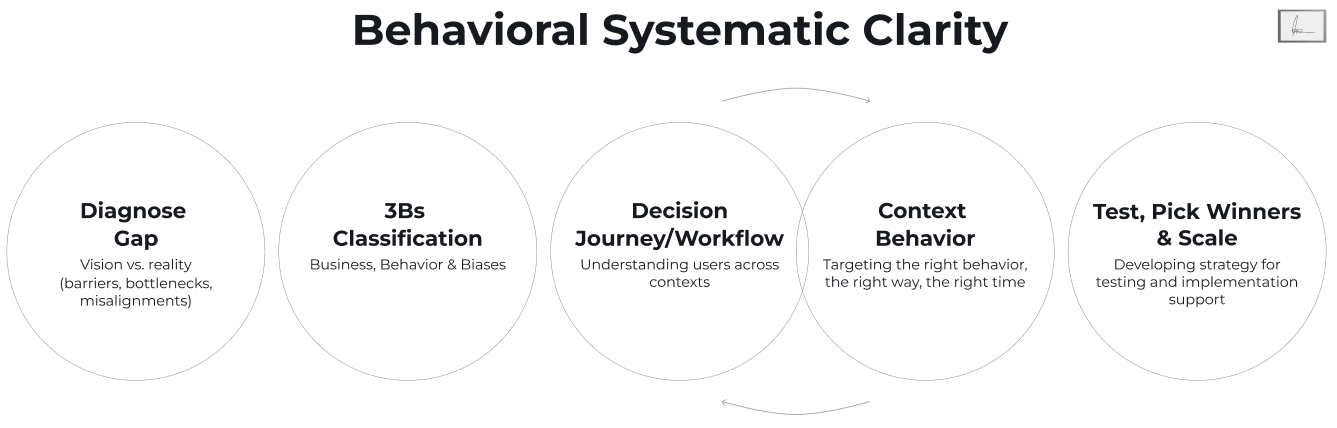
Part 1: Diagnose the Gap
The first step isn’t jumping to solutions. It’s making sure the founder’s problem is actually the problem. You’d be surprised how often it isn’t.
I start by understanding the business model, revenue structure, customer segments, and what’s already been tried. Then I form early hypotheses about where the real bottlenecks are hiding. Not trying to be smart here, just systematic.
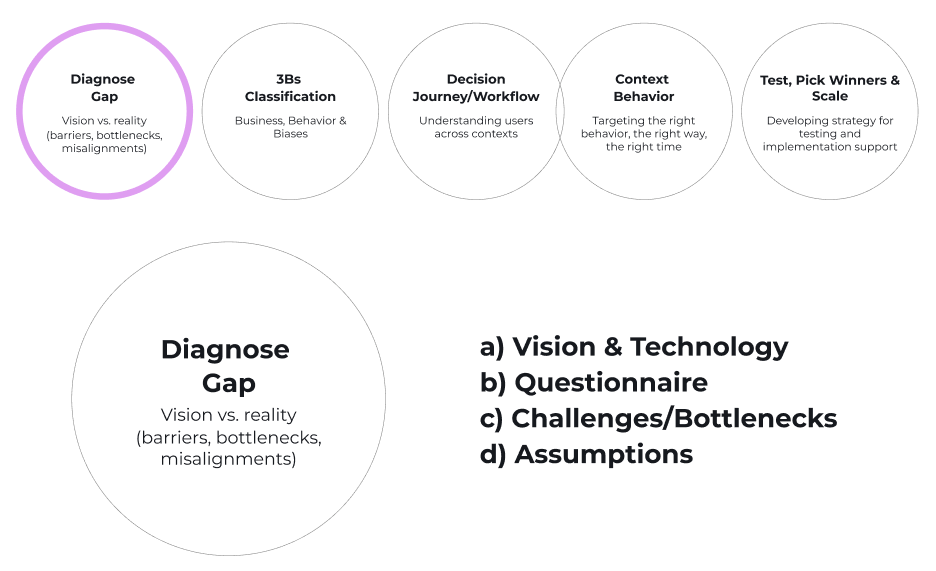
a) Vision & Technology
You need to understand what the company is actually trying to do before you can tell them how to talk about it. Vision and technology inform positioning, which determines everything from messaging to market strategy.
Their vision is straightforward: an integrated AI suite that actually moves your bottom line instead of just adding another dashboard to ignore. The technology pitch centers on “deep embedment” across operations, which in plain English means they want to be your infrastructure, not just another tool.
The behavioral bet here is simple: e-commerce operators are so exhausted from frankensteining solutions together (search tool A, chatbot B, analytics C) that they’ll embrace a single vendor if it promises to just work.
They position themselves as practitioners who “felt your pain” rather than theorists, which is smart trust-building in a space drowning in vaporware. The “forged in e-commerce trenches” narrative is solid. Whether the technology can actually deliver on the “rewire everything” promise without becoming another expensive experiment that gets abandoned in six months? That’s what we’re here to figure out.
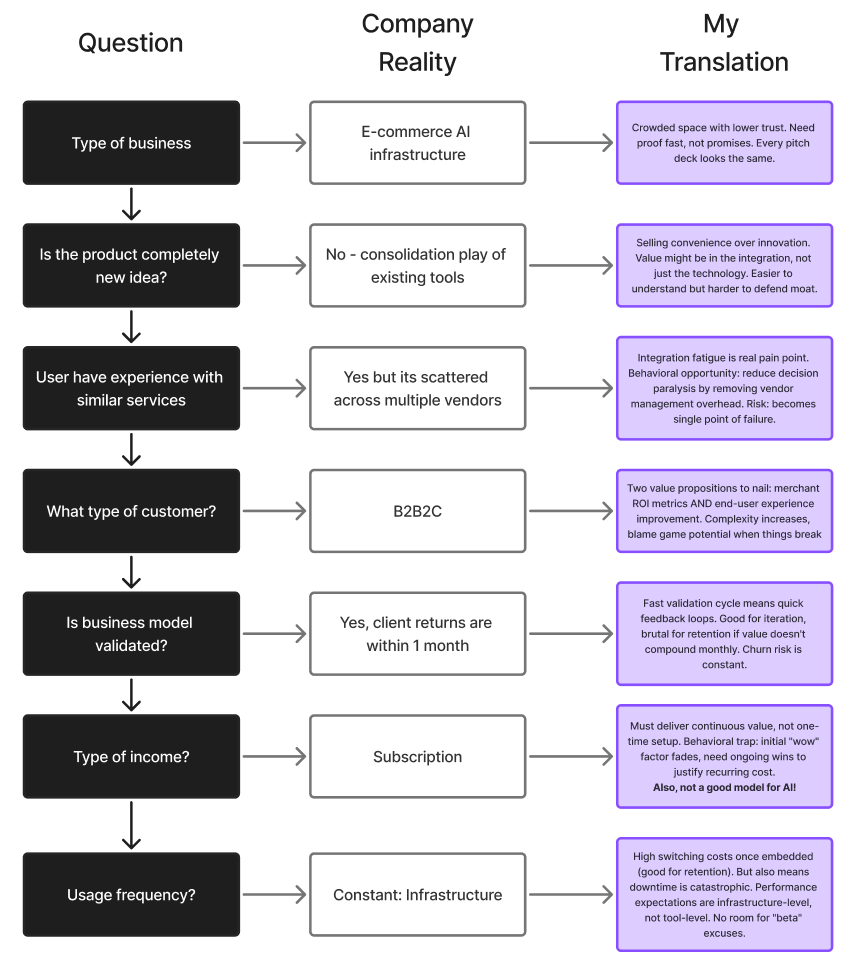
b) The Questionnaire
I use a diagnostic framework to classify any business quickly. It’s basically a decision tree that reveals the core dynamics without spending weeks in discovery.
Here’s how it breaks down for this startup:
c) Top 3 Bottlenecks
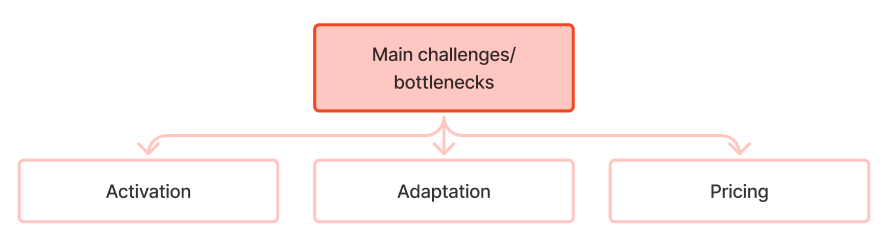
After the initial diagnostic, I identified three critical problems. Not the ten things they could improve, the three that would actually move the needle:
1. Activation Failure
People sign up but never reach the value milestones. The product delivers if you implement it fully, but the onboarding doesn’t get people there. Classic “leaking gas tank” problem.
2. Adaptation Complexity
Even when clients start implementing, they get overwhelmed by choices. No clear roadmap of what to do first, what matters most, or how to sequence the rollout. Analysis paralysis at scale.
3. Pricing Misalignment
If clients truly see direct ROI in month one, the current fee structure is either too low or too risky. The pricing model doesn’t match the value delivery or create proper commitment mechanisms.
Fix these three, and you’re not just patching holes. You’re building a sustainable growth engine.
d) Early Assumptions
Here’s where I start forming hypotheses based on what I know so far. Not rigid, just directional.
Trust is the bottleneck, not features
This is AI in 2026. Everyone’s selling “transformation.” The technology probably works. The question is whether businesses will bet their infrastructure on it. That’s a trust problem, not a product problem.
You know, the saying “nobody ever got fired for buying IBM” is at its essence about risk management.
B2B2C means double the behavior design
You’re not just solving for your direct client (the e-commerce operator). You’re also responsible for their customer experience. If the AI chatbot confuses shoppers or the search results suck, your contract doesn’t get renewed. This changes everything about how you measure success.
The “month one ROI” is your weapon
They mentioned clients see returns in the first month. This is gold. But it’s buried in their messaging and not being weaponized properly. If this is real, it completely changes the pricing and commitment strategy.
They’re selling partly an infrastructure, but communicating only like a tool
When you say “complete AI enablement” and “transform your store,” you sound like every other AI company. But if you’re actually infrastructure, you also then need to talk about reliability, integration depth, and downtime risk. Different category, different language.
These assumptions give us enough to start the next phase: classifying the business model in behavioral terms.
Part 2: The 3Bs Classification
Now we go deeper. This is where I classify the business across three dimensions: Business model, Behavior patterns, and Biases that matter.
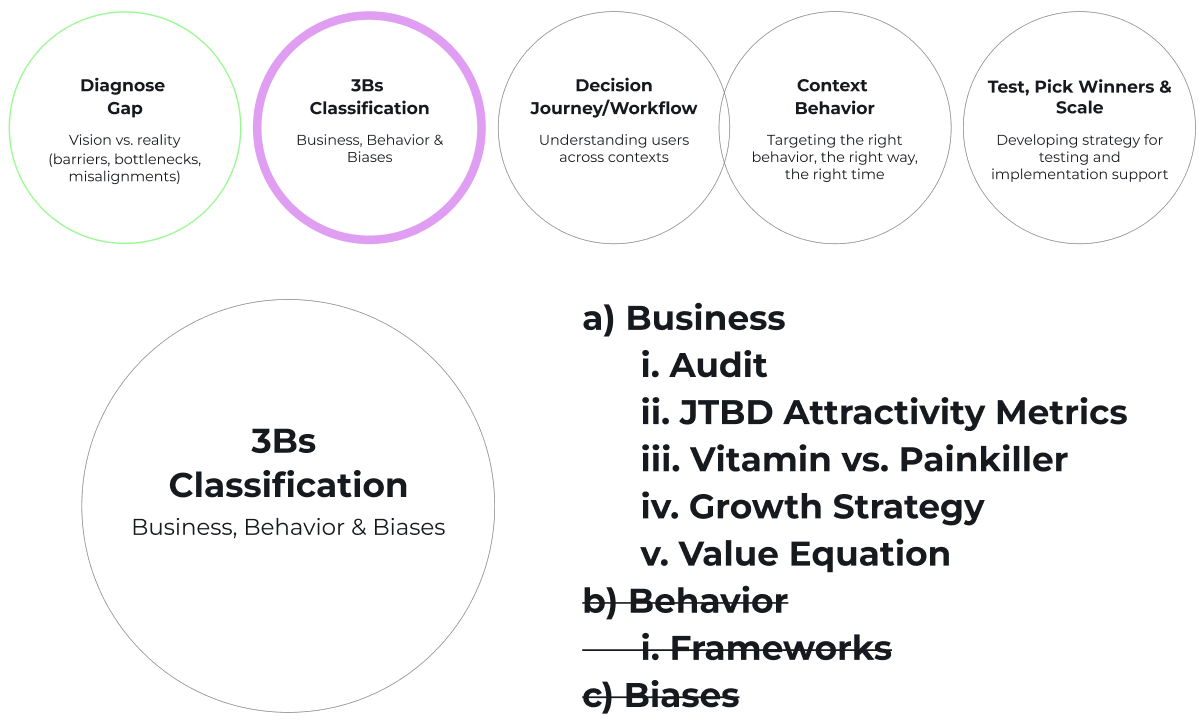
This isn’t academic categorization for the sake of it. Each classification reveals specific levers you can pull and traps you need to avoid.
i. Business Audit: The Copy Problem
First thing I did was audit their website, product materials, and messaging. Not just to “get familiar” with the product, but to spot red flags in how they’re positioning themselves.
Here’s what they’re saying on their homepage:

“We are just another AI company...until you see the ROI. We’re the team turning science fiction into profit margins, making AI that pays for itself from day one.”
Let’s break this down.
The “just another AI company” line
This is an attempt at two-sided messaging, a persuasion technique where you acknowledge an obvious disadvantage first, then hit them with the “but here’s why we’re different” pivot.

Think Volkswagen’s “Think Small” campaign that made the Beetle’s tiny size the selling point.

The execution here is prone to bad misunderstanding.
“We ARE just another AI company” is a definitive statement that might land wrong in many cases. You’re literally affirming the thing you want them to dismiss. I understand the approach, and I like it, but we need to minimize the stuff where it can backfire.
Examples of a better approach: “We often look like another AI company...until you experience the ROI.” Or even a question format: “Another AI e-commerce tool? Might look like it. But our customers’ ROIs tell a different story.”
Small difference in wording, massive difference in psychological positioning.
The “science fiction into profit margins” line
Who talks like this? Not an overworked, low-margin, utility-focused e-commerce operator. Definitely not their customer.
Maybe this language worked in 2021 when AI felt like magic. In 2025, AI is real, commoditized, everyone’s using it, but very few make real money with it. Calling it “science fiction” could make you sound, as Daryl Hall & John Oates would sing, ‘you’re out of touch’.
I’m not even sure what this sentence is trying to communicate. It’s the kind of copy that sounds impressive in a pitch deck but means nothing to the person who needs to justify the expense to their CFO.
Why this matters
Most often, it’s not your design, product, or strategy that’s killing you. It’s the copy. Copy creates the value gap (the distance between what you say you deliver and what you actually deliver) or worse, creates confusion about what you’re even selling.

Get the language wrong, and you’re fighting an uphill battle before anyone even tries the product.
ii. JTBD Attractivity Analysis
Next, I need to figure out how attractive the product actually is to potential customers. I use a simplified version of the Jobs-to-be-Done framework from Bob Moesta.
The forces model works like this:
Push = Pain with current situation
Pull = Attraction of new solution
Anxiety = Fear about the new solution
Habit = Comfort with current way
The formula: (Push + Pull) > (Anxiety + Habit)
If the left side doesn’t outweigh the right side, people don’t switch. Simple as that.
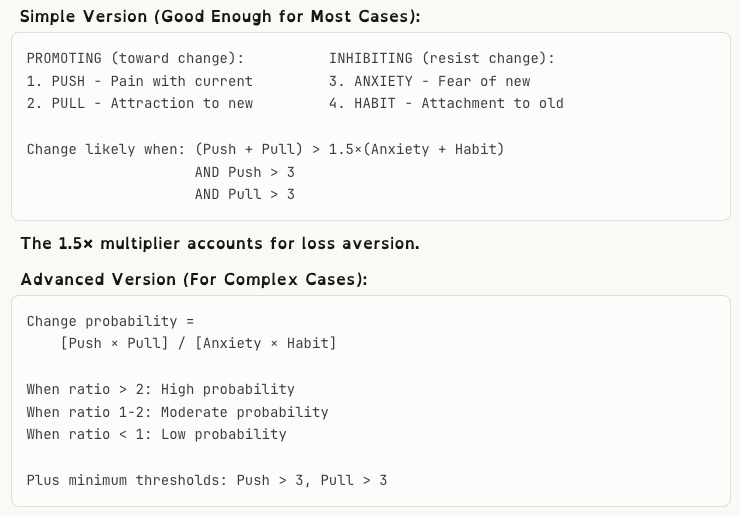
Here’s how it maps for this startup:
Push: Too many providers, inability to cover all needs
→ This is moderate. Current systems work, just annoying to manage.
Pull: ROI in first month, unified provider, simpler infrastructure
→ This is strong. Really strong.
Anxiety: Single point of failure, integration complexity, unknown impact on business
→ This is STRONGER. Way stronger. This is the killer.
Habit: Current fragmented setup is familiar, existing vendor relationships
→ This is weak. Almost nonexistent. Nobody loves managing five different tools.
The diagnosis: Pull is strong, but Anxiety crushes it. The lack of visual proof, case studies, and a clear onboarding roadmap on their landing page is costing them deals. People want to believe the ROI claim, but they’re terrified of the integration process.
This tells me exactly where to focus: reduce anxiety through proof and process clarity, not just boost the pull with better marketing.
iii. Vitamin vs. Painkiller
I always ask founders whether their product is a vitamin or a painkiller because it completely changes how you communicate.
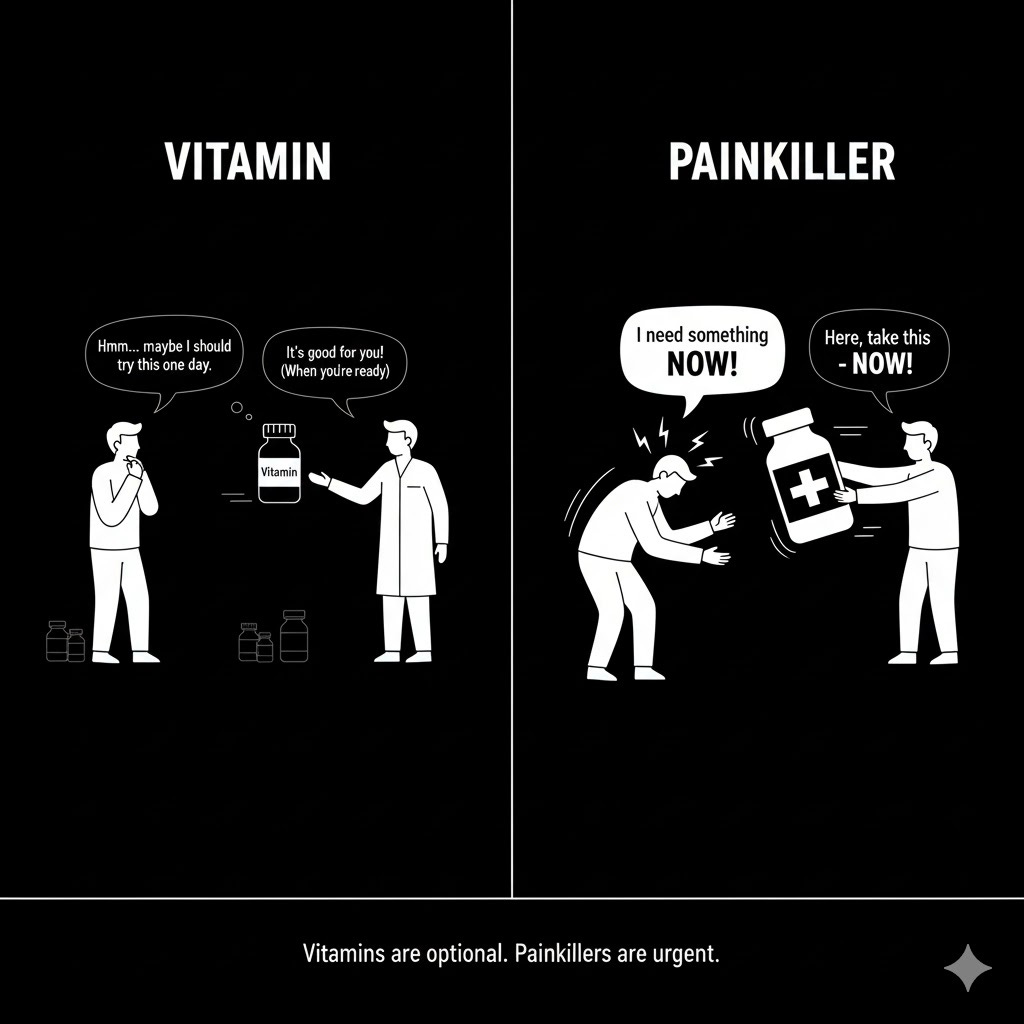
Painkillers solve immediate, urgent, painful problems. Customers need them now. There’s emotional weight and willingness to pay.
Vitamins are “good for you” solutions that promise long-term improvement. People know they should take them, but there’s no urgency. Easy to postpone. Easy to forget.
This isn’t binary, it’s a spectrum.
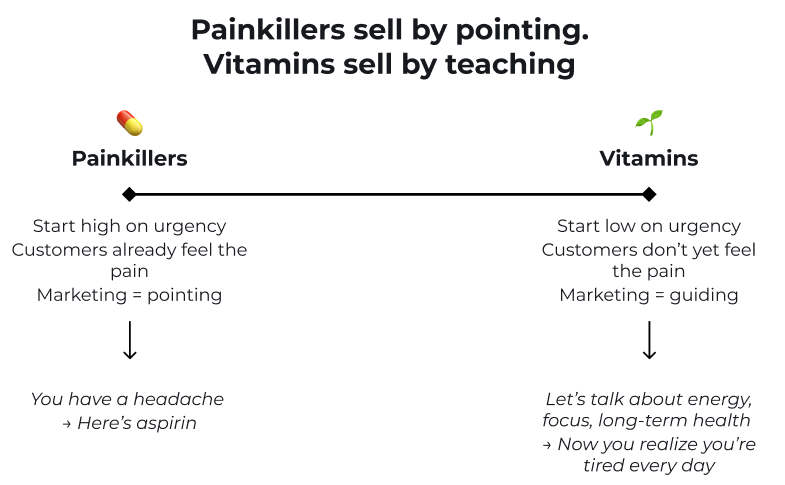
The problem? Founders always think their product is a painkiller because it’s so good that people obviously need it. But if you’re more vitamin than you think, you need way more market education.
With vitamins, you can’t just point out pain points. You have to navigate people to the realization that the pain is real, urgent, and your product can fix it.
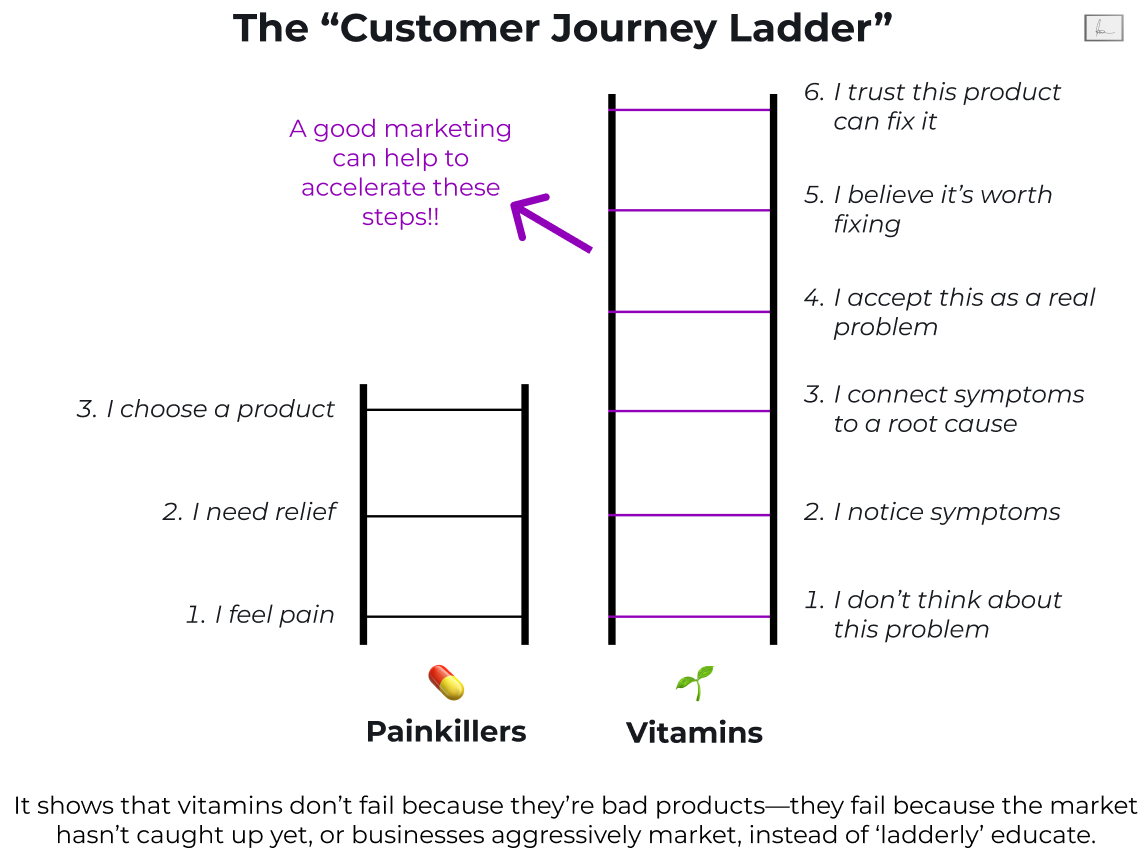
This startup is replacing current systems that work (poorly, but they work) with a more efficient one. That’s more vitamin territory. But they’re communicating like they’re selling emergency medicine.
The “turning science fiction into profit margins” line? That does neither. It doesn’t educate, and it doesn’t create urgency. It just confuses.
iv. Growth Model: SLG vs. PLG
Having clarity on whether you’re Sales-Led Growth or Product-Led Growth changes everything: marketing, sales, product, operations.
All of it.
SLG (Sales-Led Growth): Growth driven by a sales team. Reps educate customers, run demos, manage long cycles, close deals. Used for high-touch, complex, or high-ACV products.
PLG (Product-Led Growth): Growth driven by the product itself. Users try it through self-serve (freemium, free trials), experience value quickly, convert without heavy sales. Works for products with fast time-to-value and broad appeal.
This isn’t either/or for me. It’s a spectrum. But you should know where you’re investing 75% of your energy.
For this startup? Start with Sales-Led Growth.
Here’s why: B2B2C infrastructure with complex integration needs high-touch onboarding. You can’t just throw people at a signup form with simple instructions or documentation and hope they figure it out. They won’t.
The strategy: Start SLG with personal assistance for all leads through buying and implementation. Document everything. Then gradually add PLG features as patterns emerge.
If you scale too fast before nailing the process, you’ll break the product experience, your team, or both.
The startup here is missing behavioral clarity, which leads to expensive guessing games and burned resources.
v. Value Equation Audit

I borrowed this formula from Alex Hormozi. It’s a simple, beautiful way to think about your offer:
Value = (Dream Outcome × Perceived Likelihood) / (Time Delay × Effort & Sacrifice)
Translation: Value goes up when the outcome is bigger and feels achievable. Value goes down when it takes forever or requires massive effort.
Let’s audit the startup’s messaging through this lens:
Dream Outcome: “Transform how people discover, explore, and purchase products online”
→ Well said. Clear, ambitious, specific.
Perceived Likelihood: No clear description of the process, no visible path to success
→ Problem. Big problem.
Time Delay: “Paying for itself from day one”
→ Sounds good. Maybe too good. Risks coming off as bullshit.
Effort & Sacrifice: “Transform your store through complete AI enablement”
→ Disaster. This sounds exhausting. “Complete enablement” screams complexity and risk.
The baseline is solid, but the execution makes the offer feel harder and less credible than it should be. They need better visualization of the process and less scary language around the effort required.
Fix the language and you fix perceived value. No product changes needed.
What we know so far:
The business model is solid. The product works. The messaging is actively working against them. Anxiety is the primary barrier to conversion, not lack of awareness or interest. The pull is there, but trust isn’t.
Now we need to map the actual customer journey to see where behavior breaks down.
Part 3: Decision Journey/Workflow
Understanding user behavior means mapping how people actually move through your product, not how you wish they would. Every step, every decision point, every moment where they think “should I keep going or bail?”
For most products, this is already complex. For B2B2C products? It’s twice as hard.
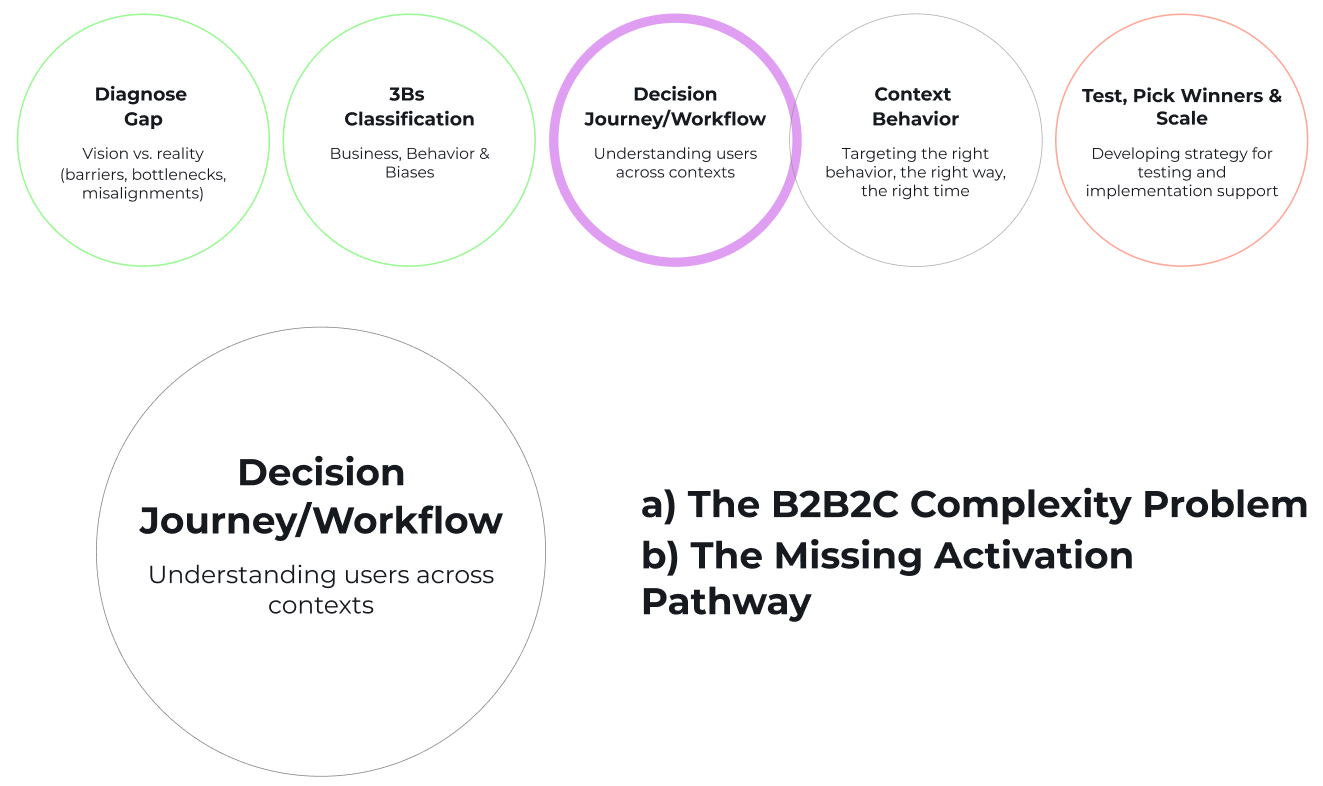
a) The B2B2C Complexity Problem
Here’s what most teams miss about B2B2C: you’re not serving one customer, you’re serving two.
Your direct client (the e-commerce operator) needs to see business results. But their customers (the shoppers) need to have a good experience with your AI features. If the AI search sucks, if the chatbot is confusing, if the recommendations are terrible, your contract doesn’t get renewed no matter how slick your dashboard looks.
Think about it like building touchscreen software for Audi cars. Sure, the software needs to integrate seamlessly with Audi’s systems. But if drivers hate using it, confused by the interface, or frustrated by the experience, Audi isn’t renewing your contract. One unhappy end user won’t kill you. Ten thousand will.
This changes everything about how you measure success and how you design the onboarding process. You need to map two behavioral journeys simultaneously and make sure both work.
b) The Missing Activation Pathway
After looking at their setup, one thing was immediately clear: they had no systematic approach to onboarding or activation.
They knew if clients completed certain actions in the platform, those clients would see returns. But clients weren’t getting to those actions. There was no roadmap, no clear “do this, then this, then this” sequence. Just a product with a bunch of features and the assumption that smart people would figure it out.
They won’t.
Optimize your backend processes first—onboarding, activation, value delivery—and you get cheaper customer acquisition, higher satisfaction, and organic growth through referrals, which in B2B is gold.
What This Means For Our Startup
The startup needed to map two things:
1. The client’s journey (the e-commerce operator)
What steps do they need to take to integrate the AI suite? What decisions do they face? Where do they get stuck? What mini-wins can we surface along the way to keep them engaged?
2. The end-user’s journey (the shopper)
How does their experience change when the AI features go live? What confuses them? What delights them? Where does the AI fail in ways that make the merchant look bad?
Most B2B companies obsess over their direct client and forget about the end user entirely. Then they wonder why contracts don’t renew even though the “product works fine.”
Without clear customer journey maps for both, you’re just guessing. And expensive guessing at that.
When I worked at Exponea (later acquired by Bloomreach), one of Slovakia’s best startups with an innovative marketing automation platform, they understood this deeply. They didn’t just provide documentation on how to use their product. They created customized content to help clients run successful campaigns. The innovation team I was part of developed strategies and solutions for e-commerce clients that barely had anything to do with marketing automation itself.
Sometimes, especially at the beginning, you don’t just win by providing good service to your client. You win by providing exceptional service to your customers.
The takeaway: The startup needed to stop thinking about “features” and start thinking about “behavioral pathways.” Two of them, running in parallel, both need clear value events to prevent interest from depleting before full value kicks in.
Now we know where behavior breaks down. Time to fix it.
Part 4: Context Behavior (The Solutions)
We’ve diagnosed the problems. We’ve classified the business. We’ve mapped where behavior breaks. Now we fix it.
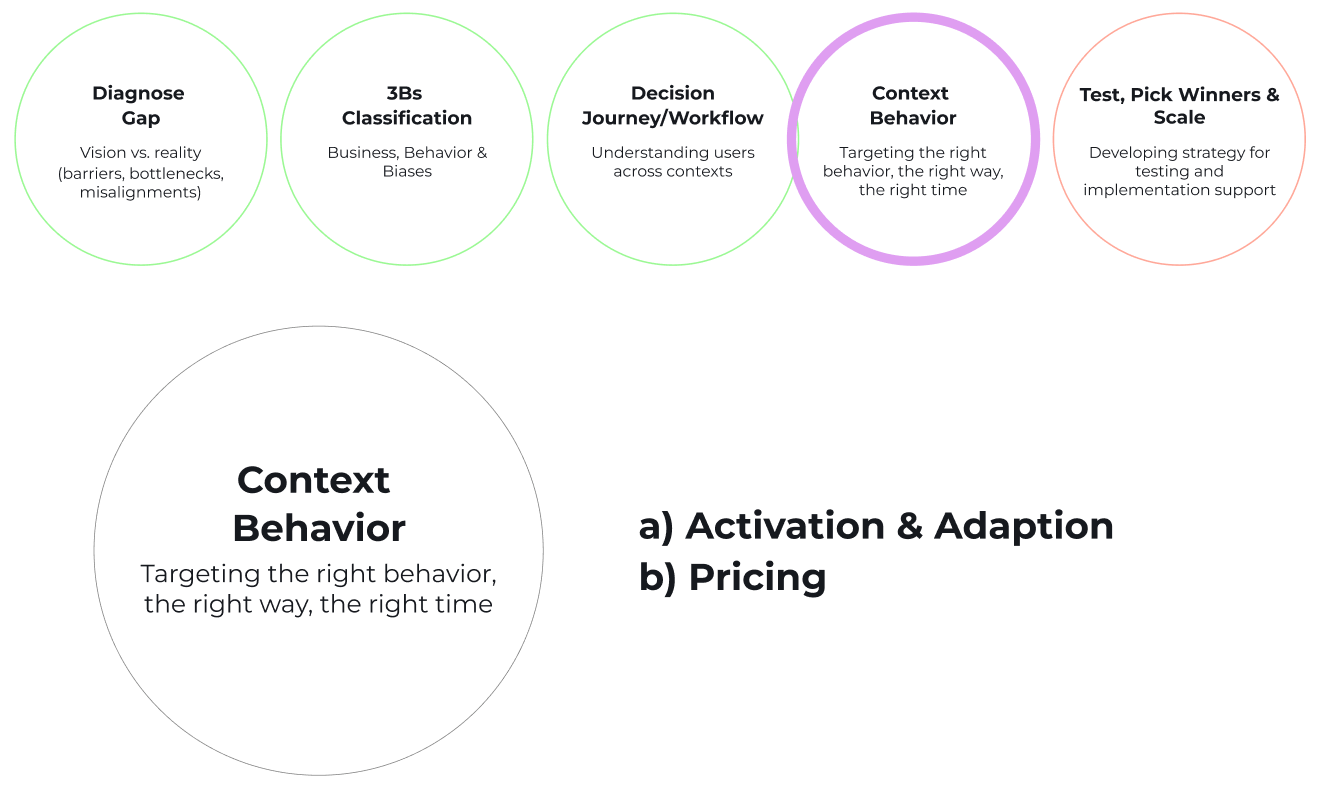
This is where behavioral architecture matters. Not just “let’s improve onboarding” or “let’s tweak pricing.” We’re applying specific behavioral insights to specific bottlenecks with measurable outcomes in mind.
Let’s tackle the two biggest levers: Activation/Adaptation and Pricing.
Problem 1: Activation & Adaptation
The Real Problem
The startup knows that clients who complete certain platform actions see ROI in the first month. The problem? Most clients never complete those actions. They sign up, look around, get overwhelmed, and churn before experiencing any value.
No clear onboarding strategy. No process design. Just a product with features and an assumption that smart people will figure it out.
This is the classic mistake: optimizing for acquisition while your activation process is broken. It’s like having a sports car with a leaking gas tank and people screaming, “just pour more gas in” while you’re standing there thinking “fix the fucking hole first.”
Competitive Inspiration: Superhuman
I looked for success stories. Found one worth copying.
Superhuman, the email client, nailed high-touch onboarding for a complex product. Their approach is documented in the excellent case study “How Superhuman Grows.” Here are the key principles:
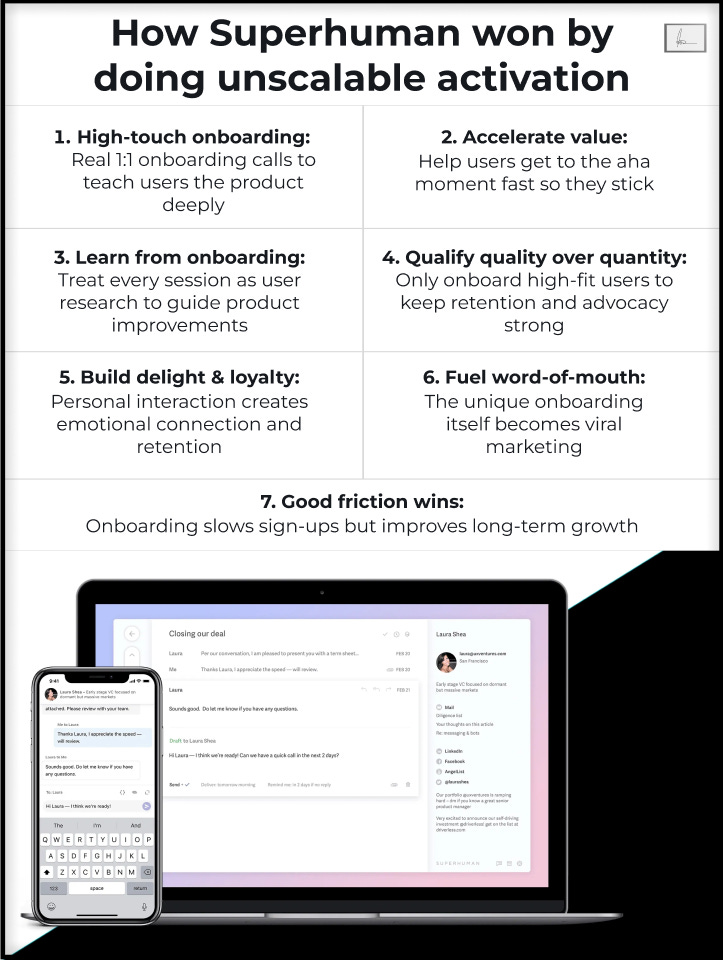
High-touch onboarding: Real 1:1 onboarding calls to teach users the product deeply
Qualify quality over quantity: Only onboard high-fit users to keep retention and advocacy strong
Learn from onboarding: Treat every session as user research to guide product improvements
Accelerate value: Help users get to the aha moment fast so they stick
Build delight & loyalty: Personal interaction creates emotional connection and retention
Fuel word-of-mouth: The unique onboarding itself becomes viral marketing
Good friction wins: Onboarding slows sign-ups but improves long-term growth
This isn’t about copying Superhuman exactly. It’s about recognizing that for complex B2B2C infrastructure, high-touch onboarding at the beginning isn’t a cost, it’s an investment.
Behavioral Barriers to Address
Two specific cognitive patterns are killing the startup’s activation:
Overchoice paralysis: When people face too many options, they struggle to make decisions and often default to doing nothing. The startup’s platform has multiple features, multiple integration points, and no clear “start here” signal. Analysis paralysis at scale.
Perceived effort: People’s estimation of how hard something will be often exceeds the actual difficulty. Even if integration isn’t that complex, if the messaging makes it sound overwhelming (”complete AI enablement,” “transform your store”), people assume it’s too much work and bail before starting.
The fix isn’t just better UX. It’s behavioral architecture in how you sequence and communicate the process.
Immediate Actions
Here’s what the startup needs to do:
1. Reverse engineer successful clients
Pick 5-10 ideal clients from different segments who successfully integrated and saw strong results. Interview them. Find out:
What type of e-commerce operation were they?
What specific features did they implement first?
What had the biggest impact on their metrics?
What almost made them quit before they saw results?
This isn’t about collecting testimonials. It’s about finding the pattern of what actually works so you can replicate it systematically.
2. Create segment-specific onboarding processes
One-size-fits-all onboarding doesn’t work for complex products. You need different paths for:
Small e-commerce (focus on quick wins, simple setup)
Mid-market (balance automation with customization)
Enterprise (integration complexity, stakeholder management)
Each segment has different pain points, different resources, and different definitions of success. Treat them differently.
3. Build a “quick wins” implementation roadmap
Don’t try to get clients to implement everything at once. Create a sequenced roadmap:
Week 1: Implement Feature X (easiest, fastest ROI)
Week 2: Add Feature Y (builds on X, compounds value)
Week 3: Integrate Feature Z (unlocks the full platform)
Each step should have clear instructions, expected time investment, and predicted impact. This reduces perceived effort (you’re not asking them to do everything) and creates momentum through early wins.
4. Track and showcase progress visibly
Create a dashboard that shows:
Implementation progress (40% complete)
Early metrics (3% improvement in conversion already)
Comparison to similar clients (you’re ahead of 60% of users at this stage)
This isn’t gamification for the sake of it. It’s making the invisible visible. People need to see they’re making progress even when full value hasn’t hit yet.
The Superhuman Insight
Paul Graham said it best: “Do things that don’t scale.”
At the beginning, you can’t automate your way to product-market fit. You need to get in the trenches with every client, understand what works, document it, and only then start building the scalable version.
The startup was trying to scale before they’d figured out what actually needed to scale. That’s backwards.
Problem 2: Pricing Strategy
The Problem
The startup charges a standard monthly fee. If clients truly see ROI in the first month like they claim, the pricing is either way too low or structured wrong.
More importantly, the pricing model doesn’t create commitment. People pay, half-implement, don’t see results (because they didn’t fully implement), then churn. The startup loses money, and the client assumes the product doesn’t work.
The Solution: Activation Rebates
Here’s a better approach suggestion based on behavioral insights: Don’t give the first month free. Instead, offer this deal:
“Pay for month one. Complete this activation checklist within 30 days. If you don’t see results that justify the price, month two is free and you can cancel anytime after that.”
Why is this better than just offering a free trial?
1. Payment creates investment
When people get something free, they don’t value it and won’t put in effort. When they pay, they pay attention. As Alex Hormozi puts it:
“If they pay, they pay attention. Most businesses lose money on customers who never activate. They buy your service, skip onboarding, ignore your calls, then churn after month two. You blame the customer. Wrong. You didn’t incentivize the right behavior. Here’s the fix: Pay customers to activate themselves.”
The math is simple. An activated customer might be worth $15,000 to your business. A non-activated customer might be worth $1,000. That $14,000 difference is your activation value. Smart businesses spend a fraction of that gap to drive activation behavior.
2. Removes risk completely
“Get your money back if it doesn’t work” changes the entire conversation. You’re no longer asking them to trust your product. You’re asking them to trust the process and your confidence in the results.
That is a big difference.

3. Triggers sunk cost psychology
Once people pay and invest effort, they’re psychologically committed. After they complete the checklist and see even small wins, they’re not leaving. The investment has been made, the habit is forming, and the second month free becomes a bonus, not a trial.
Duolingo confirmed this pattern: adding an “investment step” right after a reward increased Day 7 retention by 14%. People value what they work for.

4. The checklist holds everyone accountable
The activation checklist serves three purposes:
Gives clients a clear roadmap (reduces overwhelm)
Ensures they actually implement enough to see value
Gives you data on what’s working and where people get stuck

If someone completes the checklist and still doesn’t see results, that’s useful information. Either your checklist is wrong, or they’re not a good fit. Either way, you learn.
AI Pricing Economics (Brief Reality Check)
Traditional SaaS margins sit at 80-90%. Add a user, costs barely increase.
AI products? Margins hover around 50-60% because every user burns tokens and compute. Your costs scale unpredictably with usage.
GitHub Copilot learned this the hard way. Launched at $10/month per developer. Cost Microsoft $30/month to serve each user—losing $20 per user before accounting for anything else. Power users who actually relied on it? Those cost $80/month to serve.
This matters for the startup because their all-in-one suite isn’t just licensing software, it’s running AI models constantly. They need pricing that accounts for:
Variable compute costs based on usage
The fact that not all features cost the same to run
Power users who could spike costs 3-5x
I won’t dive deep into AI pricing models here (that’s a separate article), but the key point: if your costs scale with usage and you’re charging a flat fee, you’re setting yourself up for a nasty surprise when successful clients start using the product heavily.
The startup should experiment with:
Base subscription + usage overages for high-intensity features
Credit-based pricing (buy credits, spend them across features)
Outcome-based pricing for specific modules (pay per resolved support ticket, pay per conversion improvement)
But first, they need to fix activation. Pricing optimization doesn’t matter if people churn before experiencing value.
The pattern here: Every solution is tied to a specific behavioral insight. We’re not just saying “improve onboarding.” We’re targeting overchoice paralysis with sequenced implementation. We’re not just saying “change pricing.” We’re using activation rebates to trigger commitment and sunk cost psychology.
This is behavioral architecture. Designing the structure of how people interact with your product, not just the features.
What This Means For You
Most founders optimize for acquisition. Get more users, run more ads, improve conversion rates on the landing page. They’re pouring gas into a leaking tank.
Fix the backend first. Activation, onboarding, value delivery, the journey from signup to “holy shit, this actually works.” That’s where sustainable growth lives.
For this startup, the roadmap is clear:
High-touch onboarding inspired by Superhuman’s model
Activation rebates that ensure commitment and completion
Staged rollout that prevents overwhelm through sequenced quick wins
Dual journey mapping for both merchant and end-user experiences
None of this required changing the product. The technology already worked. What was broken was the behavioral architecture around it—how people discovered value, how they were guided through implementation, how commitment was created.
If you’re building B2B2C, remember: you’re not solving one behavior problem, you’re solving two. Your direct client needs business results. Their customers need a good experience. Nail both or die.
And if you’re building anything with AI, understand that the gap between first use and full value is your biggest vulnerability. Engineer value during the learning phase itself. Show progress, surface patterns, create mini-wins. Don’t just wait for the AI to get smart enough to deliver.
The companies that win aren’t the ones with the best technology. They’re the ones that understand how humans actually behave when faced with new tools, complexity, and the decision to invest time in something that promises future value.
That’s behavioral architecture. That’s what this methodology is for.
If you have questions or want to discuss how this applies to your product, let me know.
— Peter
This piece really made me think about how crucial user activation is, even when the underlying AI tech is brilliant. I sometimes wonder if for B2B2C, it's also about building initial trust or demonstrating immediate, tangible value to the human user, not just smooth technical onboarding.